
Overview
Role: Solo Creator, Designer, and Writer
Developer: Solo Creations (DigiPen student projects)
Overview: A Wistful Cry is a short narrative game in ink following a man struggling with his past traumas. Familiar Delusion is a short narrative game in Twine following a slightly delusional young man trying to do his best to support his family.
Medium: Video Games (ink and Twine)
Timeframe: February 2024 – March 2024
Contributions
As the sole creator of these projects, I plotted, scripted, and fully implemented both A Wistful Cry and Familiar Delusion into ink and Twine, respectively. While small in scope and under several restrictions, these projects allowed me to sharpen my skills with crafting branching narratives and shortform writing.
Some notable aspects of my work include:
● Writing with a specific audience and context in mind to maximize their engagement
● Utilizing technical systems to augment writing and enhance the player’s narrative experience

Public Domain (CC0) photo uploaded online
Writing for an Audience
Both A Wistful Cry and Familiar Delusion were developed with an audience and context in mind, as they were to be presented live and played through by my narrative design peers as a group. Knowing this, I wrote these two games in a way that maximized their appeal to that particular audience and within that gameplay environment.
For example, I anticipated that a large group of players going through the game together would have a strong tendency to gravitate towards comedic options whenever those were presented. With that in mind, my placement of ‘joke options’ was careful and deliberate.
In Familiar Delusion, a less serious story, I placed many of the funniest or most amusing interactions behind these choices to increase the likelihood of players running into them and feeling satisfied with their choices.
Conversely, I included or omitted comedic options in A Wistful Cry depending on how deeply I wanted the players to consider a particular choice. In some segments, they were used to add a lighthearted break; for serious decisions, however, the sudden lack of them encouraged players to think harder about their choice rather than defaulting to a funny option.
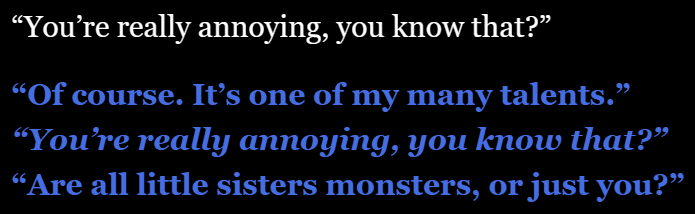
A particular set of responses in Familiar Delusion that garnered considerable audience reaction, including one person who eagerly read aloud the second option unprompted in the exact mocking tone I intended
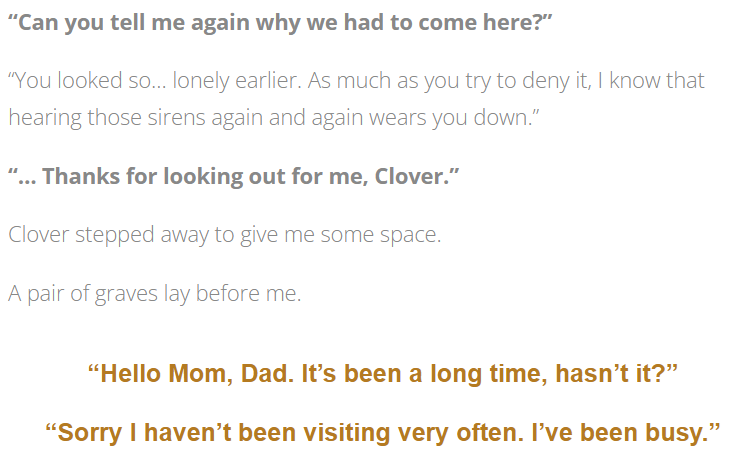
To accommodate this sudden emotional reveal in A Wistful Cry, I incorporated a number of lighthearted dialogue options in the previous scene to maximize the contrast (and thus effect) of this scene
Utilizing Technical Systems to Enhance Narrative
Although ink and Twine are, by default, relatively simple text-adventure engines, I researched and implemented technical features into A Wistful Cry and Familiar Delusion to make the narrative experience more engaging.
The most notable example is the custom text-rendering logic I created for Familiar Delusion. Normally, Twine displays all text per screen instantly, but I wanted to give a more natural feeling flow to speech by modulating the way text displays. To accomplish this, I programmed an entirely self-made system that displays text character-by-character, reminiscent of RPGs or similar games.
Furthermore, I modified the display speed of text in some places for narrative effect, such as adding mid-line pauses to emulate real speech or punctuate certain words. Rather than letting the technical end of these games merely be a vehicle to deliver the script, I employed the technical systems to actively augment the narrative.
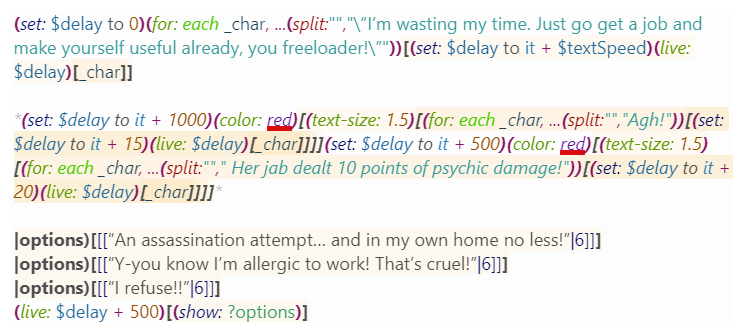
The implementation of my code logic in a particular node of Familiar Delusion

Despite the lack of voice acting or sound, I leveraged my text display system to convey nuanced tone and voice information in the dialogue of Familiar Delusion, such as in this gag
Working under Constraints
These projects carried various constraints and requirements I adhered to when developing them. For example, total playthrough duration and characters-per-line were limited, and I frequently cut down my original drafts to accommodate these restrictions. Although I sometimes had to cut portions I would’ve rather kept, I worked to make the best use of the space available and slim down while maintaining the heart of the narrative.
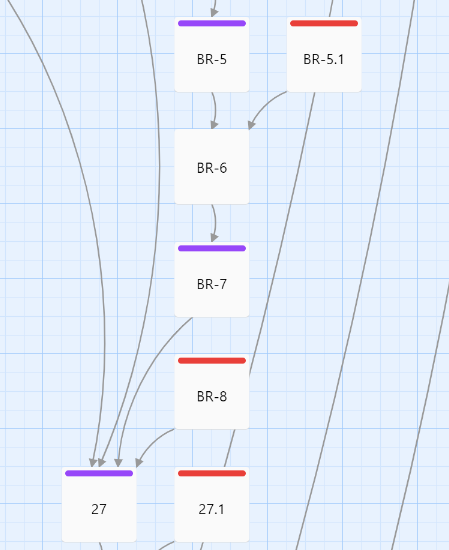
A section of Familiar Delusion heavily modified to accommodate time restraints (the purple bar is a modified node; red is a cut node)
 Connor Runyon