
Overview
Role: Solo Creator, Designer, and Writer
Developer: Solo Creation (DigiPen student project)
Overview: The Khentós World Bible details the setting of Khentós, a continent in the aetherpunk-style fantasy world of Tyashír, including its unique cultures, factions, history, geography, ecology, languages, and more.
Medium: Documentation
Timeframe: September 2024 – December 2024
Contributions
As this project’s sole creator, I developed the entire world of Khentós and compiled it into a 104-page, ~31,000 word document. In order to flesh out the world realistically, I researched and referenced real-world social, ecological, and geographical sciences to emulate trends and patterns with as much accuracy as possible.
Click here to see some writing samples or view the full document.
Some notable aspects of my work include:
● Taking a simple, one-paragraph concept and developing it into a complete, fleshed-out world
● Designing world elements to interact with one another rather than leaving each to exist in a vacuum

Public Domain image by Gustave Doré in London: A Pilgrimage (1872)
Expanding on a Concept
I began the development of Khentós with the following high concept:
What if a net-zero quantity of magic must always exist within the world, meaning that whenever magic is produced, an equal amount of negative ‘anti-magic’ is produced in turn to preserve the equilibrium; when enough anti-magic is produced, it consolidates and mutates into monsters that threaten humanity. Rather than reject magic, most societies chose to embrace it anyway, advancing towards an industrialized era of magic-fueled technology. As magic advances humanity forward, so too does it advance the power of the monstrosities created by it in an endless cycle.
I aimed to create a world with its fair share of fantasy elements—such as the existence of magic-powered technology and monsters—while also sharing many thematic parallels with the real-world. In particular, the industrial revolution of Khentós was made to mirror the societal shifts and other consequences of the real industrial revolution, both the good and bad.
The continent of Khentós is populated by three major cultural groups: the Byàvesh, Pktanni, and Zhĭròm peoples. Each culture has its own language, ideals, traditions, and more; however, explicit care was taken to avoid monoculturalism by including subcultures and countercultural factions within each of these three broad groupings.
A Living World
A realistic world should not be static, and Khentós was designed with consideration towards how the continent’s history and cultures have changed over time to reach where they are in the modern era. For example, the modern Byàvesh culture emerged from an older civilization—the Tholhyós—which collapsed centuries prior. In order to make the world feel more cohesive and sophisticated, I frequently drew connections between these two cultures to contextualize the current state of Byàvesh society and the long-lasting impacts of historical events.
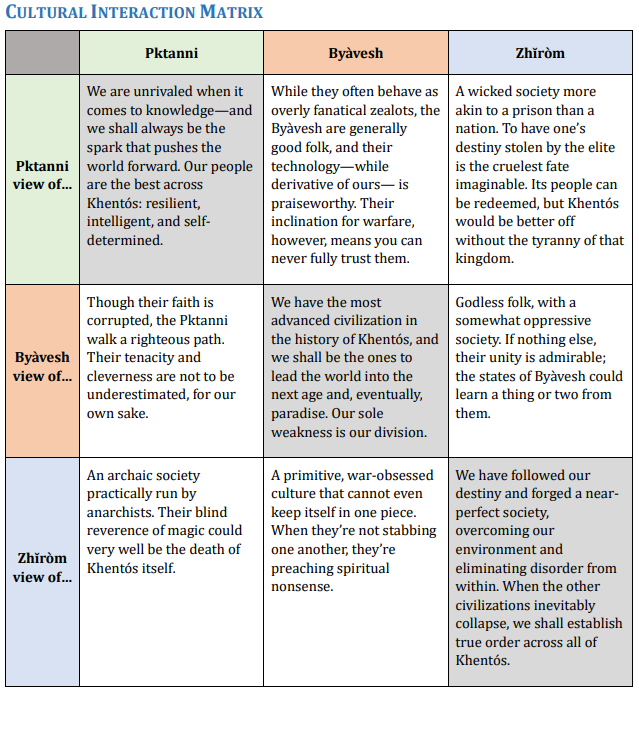
Likewise, each culture and faction does not exist in a vacuum, and their interactions with others are just as important as their individual traits. Consequently, I detailed their relationships and perspectives on each other to add another layer of depth to the world.
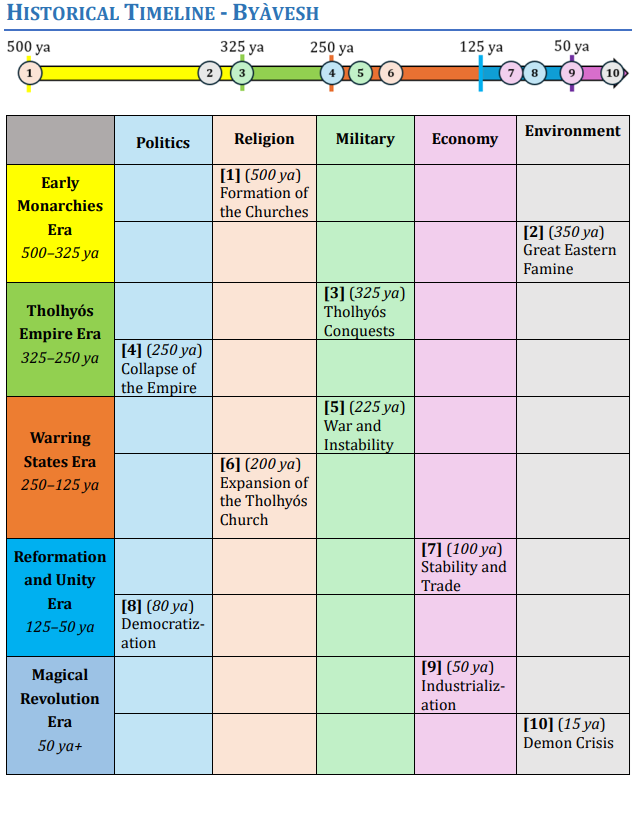

Languages
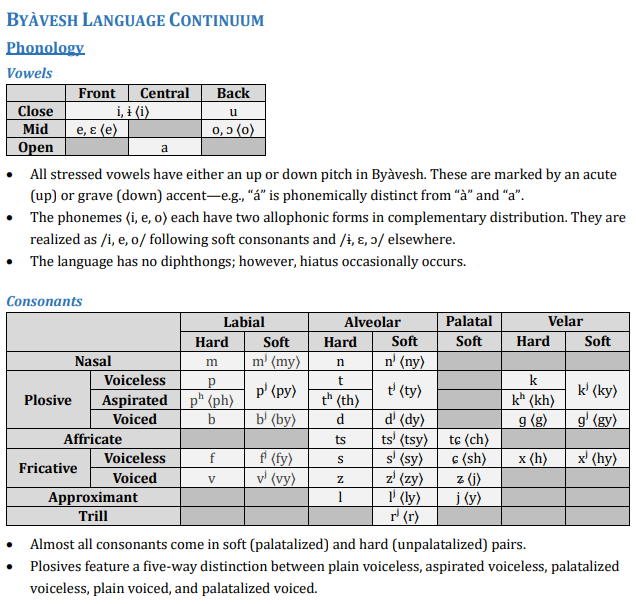
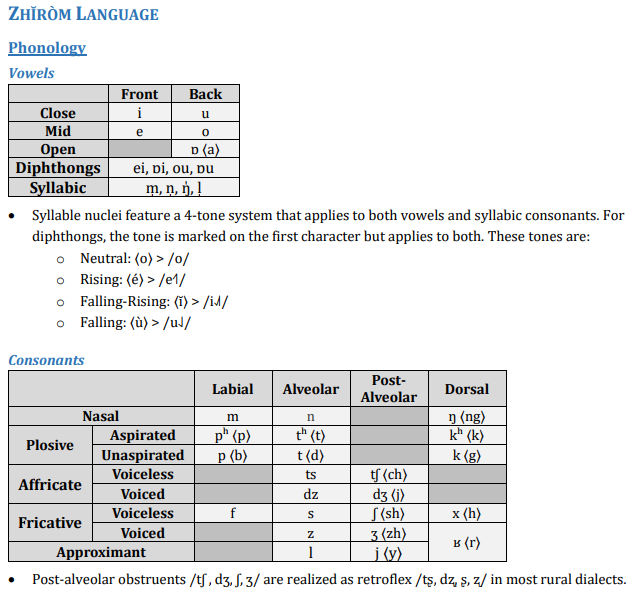
When it comes to fantasy and science fiction, language is often given little consideration. Typically, there is little linguistic consistency between the names of people and places, and rarely are fictional languages—if defined at all—anything more than relexes of English (that is, words or letters are replaced 1:1 with their fictional ‘equivalent’ while keeping grammar and spelling identical). As this is a frequently neglected aspect of worldbuilding—and given my existing knowledge of linguistics and experience with conlanging—I made it a priority to develop at least a basic outline of the major languages of Khentós.
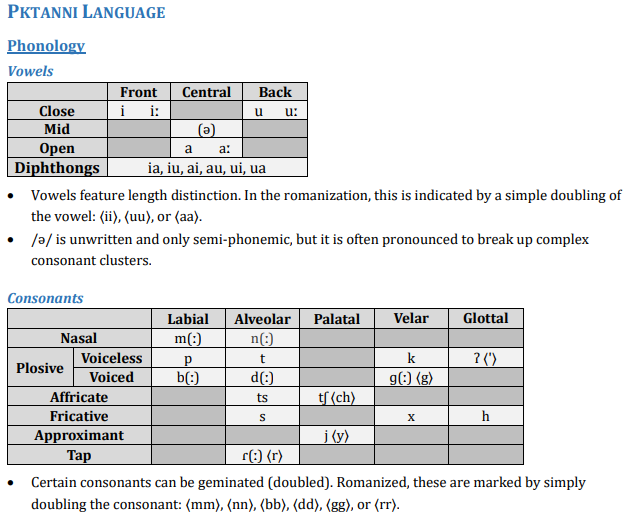
Although the three languages I designed were not fully fleshed out due to scope considerations, each was given enough detail to have a distinct phonetic flavor, allowing for consistent naming. Thus, related people and locations are unlikely to sound ‘out-of-place’ from each other, just like in real languages.
I referenced many languages from all across the world during creation, from Mandarin Chinese to Arabic to Hungarian to Georgian. By not relying too heavily on a single language or language family for inspiration, I avoided accidental parallels between my cultures and those of the real world.
Map Development
The world map of Tyashír—the larger world where Khentós is located—was designed to be as geographically accurate as possible. This included modelling plate tectonics, ocean currents, and wind patterns to determine the climates and major geographical features of each region.
Although this world bible only fleshes out Khentós, this map provides a template for further expanding the world of Tyashír via the other major continents of Namanose and Ölteff.

Tyashír World Map (Click to expand)

Zoomed-in Byàvesh Map (Click to expand)
Writing Samples
Culture: Byàvesh
The Byàvesh are distinguished by their prevalent use of industrial magical technology in the current age. They typically view magic more as a tool for inventors and engineers than a common skill everyone utilizes, and despite not being the first to adopt it, they are at the forefront of magical technology.
The Byàvesh are the largest and most influential cultural group in Khentós, though they are also the least united due to the size of the region and frequent political disputes. The many Byàvesh nations fall into conflict with each other far more often than they do with the nations of other cultures.
The Byàvesh occupy the ‘Greenlands’, the central region of Khentós composed primarily of temperate forest and grassland biomes. This is the largest and most ecologically diverse region of Khentós, with vast and fertile lands ideal for agriculture.
Culture: Zhĭròm
The Zhĭròm are the most skeptical of magic, and many are divided on the matter of its usage outside of a few, very limited contexts. Many communities ban the practice outright, while many urban centers have begun to tacitly embrace the boons of magical technology.
The Zhĭròm inhabit the ‘Drylands’, the hot southern region of Khentós consisting of savannahs and deserts. Originally, the term ‘Drylands’ referred specifically to the dry deserts in this region, but the term eventually expanded to encompass the entire area the Zhĭròm inhabited. As a result, even the savannah areas—which have a distinct wet season—are a part of the Drylands, contrary to what the name might imply.
The Zhĭròm have a longstanding tradition of using magic to terraform the land by crafting artificial oases for farms and villages to develop around. For centuries, this tradition was the only acceptable use of magic, but the Magical Revolution has once again complicated the matter as an influx of magical technology from the north is flooding into the hands of the Zhĭròm.
Faction: Church of the Five Divinities
The Church of the Five Divinities, despite being the youngest of the six major churches branching out of the ancient Byàvesh religion, is the largest and most powerful. Originally born out of the syncretism of the other churches, its acceptance of a wider variety of beliefs allowed it to gain prominence over the centuries.
It formally cemented itself as the largest church following the conquests of the Tholhyós Empire three hundred years ago, which recognized the young Church of the Five Divinities as its official religion. Though the rule of the empire was brief, it covered nearly half of the Greenlands at its height, and in that time the church had thoroughly planted its roots across the territory, surviving the empire’s collapse.
Though it only officially controls the city of Tholhyós, the church has immense influence on the many states of Byàvesh which recognize it as their official church. Due to the high level of religiosity amongst the Byàvesh populace, this influence is largely cultural and indirect, though attempts at the direct manipulation of politics by high-ranking church officials are far from uncommon.
Other: Magic
Whenever ‘positive’ mana is produced—whether by a human or machine—an equal amount of ‘negative’ anti-mana is also produced.
Mana is an invisible substance that behaves closer to energy than matter yet is distinct from both. While it does nothing on its own, the properties of mana can be modified by channeling it into physical materials. The resulting ‘modifications’ are determined by the composition and structure of said materials. By carefully arranging multiple materials in a specific pattern, these modifications can be chained together to produce practical, tangible effects. These ‘effects’ are what is known as magic.
The effects of magic can range from the simple production of a candle-sized flame to hurling a house-sized fireball. The only differences between these two are the amount of mana that must be rifted and the ‘magical formulae’ used to produce them; that is, the physical elements used and how they were arranged. The more complex or powerful the magic, the more complex and precise the corresponding formula must be.
Anti-mana is normally invisible to humans except in extreme quantities. It is naturally dense and will quickly sink deep into the earth after rifting occurs. While inert on its own, over several years, independent masses of anti-mana may converge and coagulate beneath the earth to create a demon. At the density required to form a demon, anti-mana becomes visible to the naked eye, taking on a dark grey or black shade.
 Connor Runyon