
Overview
Role: Narrative Designer, Technical Designer
Developer: Team ICEaGE (5-person DigiPen student team)
Overview: Tick Our Time Away is a narrative game following an arrogant university student in Victorian London who possesses a magical, time-traveling pocket watch. After his professor is murdered, he (and the player) must make use of his limited powers to gather evidence and identify the killer.
Medium: Video Game (articy:draft X)
Timeframe: April 2024
Contributions
On this project, I served as a narrative designer and technical designer. I worked on crafting the overarching narrative, writing several scenes across the game, and editing scripts. Additionally, I personally implemented the entire game into articy:draft X.
Some notable aspects of my work include:
● Structuring the overarching narrative and baking in nonlinearity on both micro and macro scales
● Implementing all content and gameplay functionality into articy:draft X
● Pitching the initial narrative concept and guiding the team towards that vision
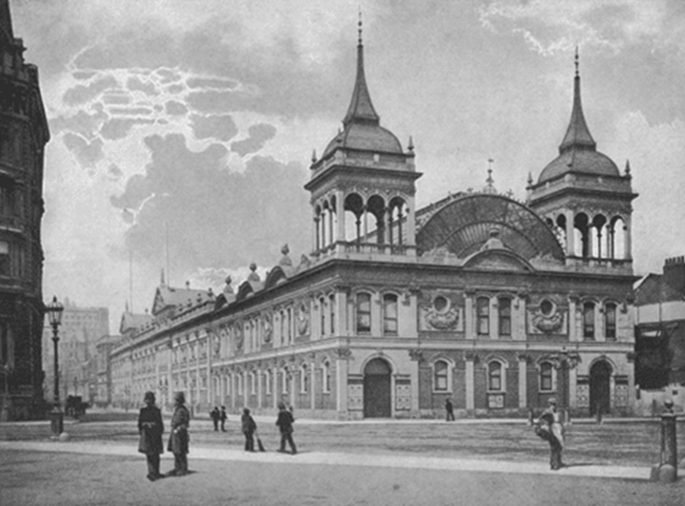
Public Domain photo from The Queen’s London: a Pictorial and Descriptive Record of the Streets, Buildings, Parks and Scenery of the Great Metropolis (1896)
Planning and Nonlinearity
As a time-travel-centered mystery, Tick Our Time Away required a lot of upfront planning to get the narrative to work. In order to create interesting interactions between the time travel and investigation mechanics, we had to plan out what evidence was available to the player during each in-game hour, which choices would have persisting consequences within and between time loops, which clues would lead to future clues in later loops, and more. I did a considerable amount of the outlining and general structuring for the story, designing it with a particular consideration towards the player’s meta experience of going through similar events multiple times.
Long-term planning also played an important role in making player choices feel impactful. By including frequent short-term callbacks, we encouraged the player to consider all of their choices; at the same time, these callbacks served to subtly indicate to them that their choices across the game would influence the narrative long-term, a promise which is delivered on through 4 unique endings and possible variation within each ending.
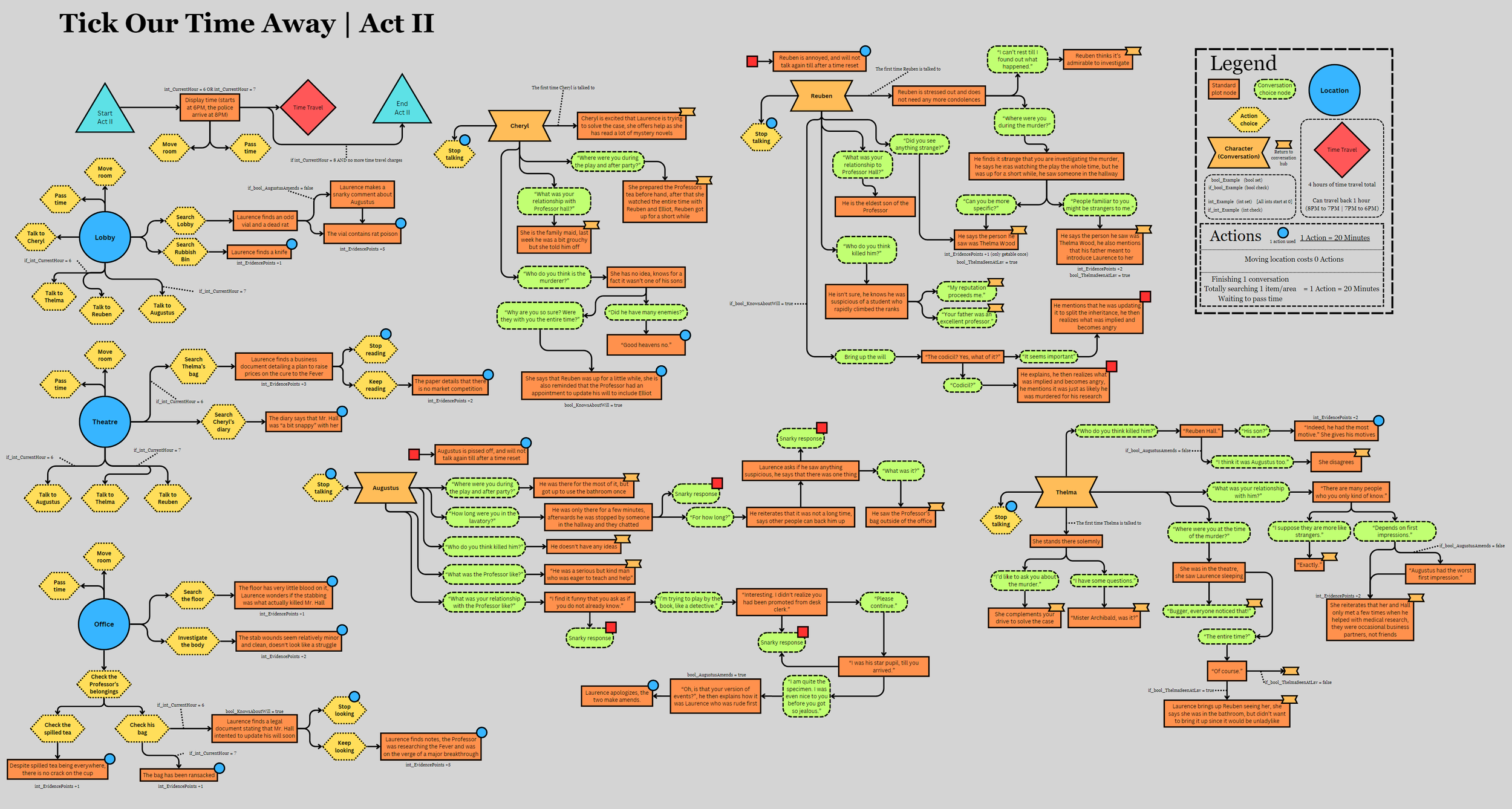
Simplified flowchart of Act II (Click to open full image)
Writing Openings
I drafted the entirety of Tick Our Time Away’s Act I, which constitutes approximately one-third of the total lines in the game. Given the core gameplay loop of interrogating, investigating, and time traveling begins right away in Act II, Act I needed to set all of the groundwork required to make the rest of the narrative work.
Most importantly, I had to introduce and characterize the entire cast to contextualize the rest of the story and give the player a starting point to go off of when investigating in Act II. Likewise, I established key relationships here that would become important later in the story. For example, the antagonistic relationship between the protagonist, Laurence, and his rival, Augustus, plays a critical role in Laurence’s ultimate character arc, so I placed considerable focus on developing a compelling dynamic between them in Act I to set up later narrative payoff.
To function as an effective hook, I also needed to keep the long opener engaging throughout. To this end, I blended comedy and intrigue in both the narration and dialogue to grab and hold the player’s attention throughout this relatively linear portion of the story.
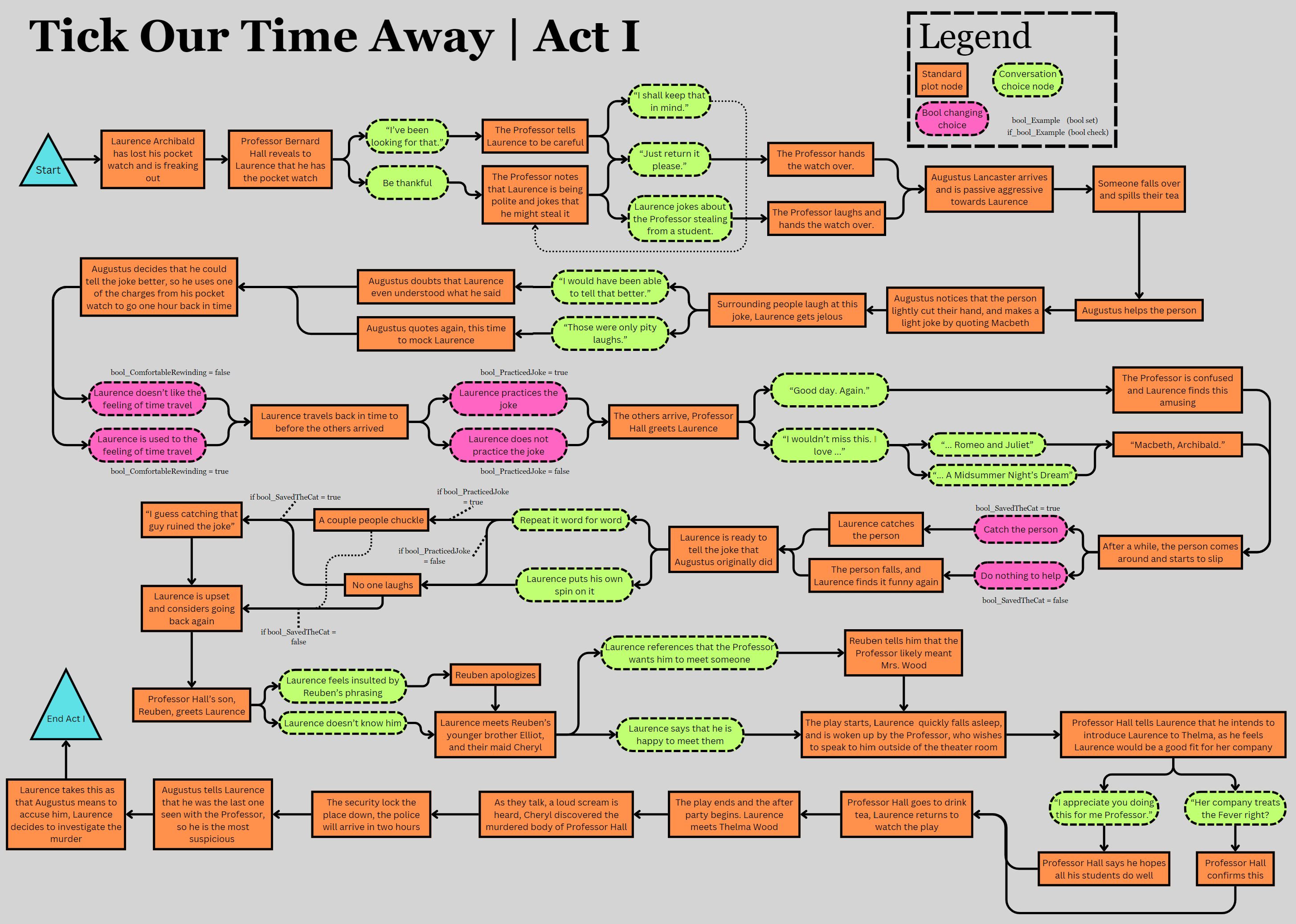
Simplified flowchart of Act I (Click to open full image)
Maintaining Team Consistency
With a whole team of writers and designers, maintaining consistency was important. The time travel and mystery aspects of the plot made accidental inconsistencies easy to produce, so identifying and fixing these mistakes—as well as matching character voice between writers—was paramount.
I did at least one editing and/or revision pass of every script in the game, including my own and those written by other team members. While editing, I focused specifically on patching grammar mistakes, identifying awkward phrasing, and realigning divergences in character voice.

Portion of an edited script I wrote (Click to expand)
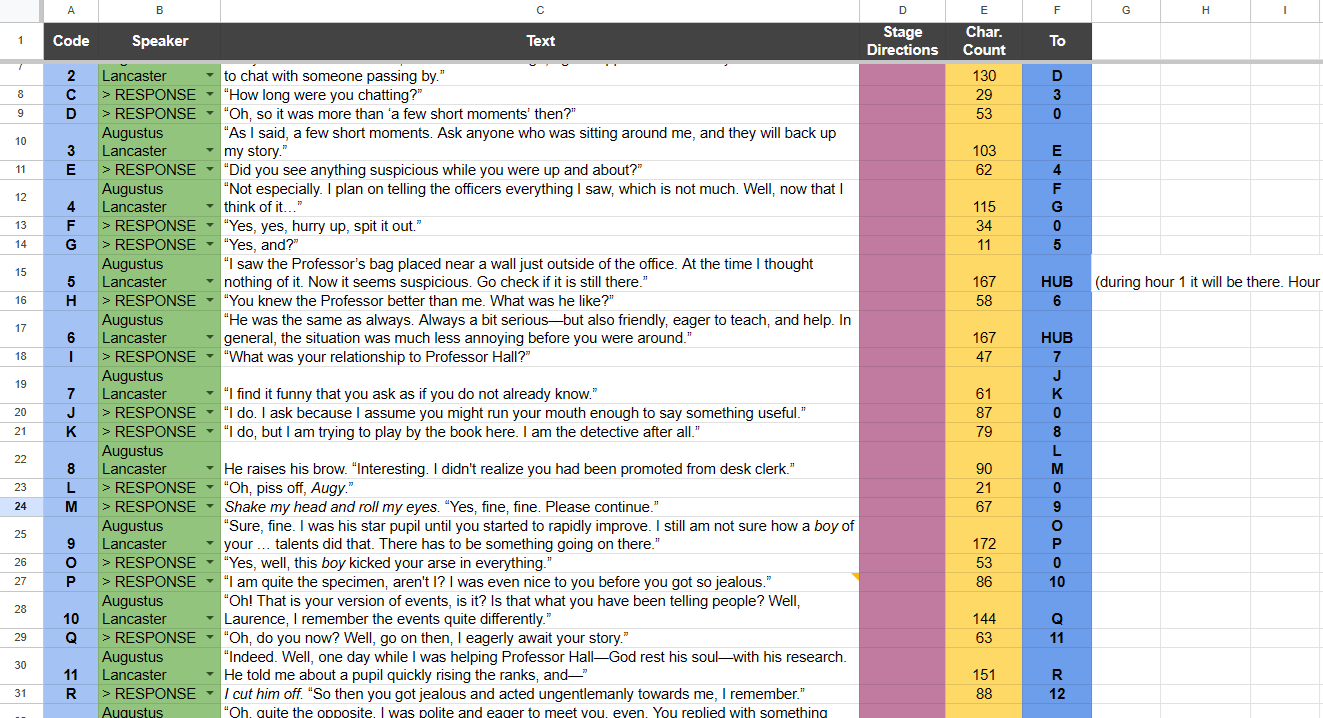
Portion of an edited script a team member wrote (Click to expand)
Technical Integration
After the scripts were written and edited, I was the sole member in charge of implementing the game into articy:draft X. This included transferring the scripts from spreadsheets into the engine, incorporating the outlined branching, and setting relevant internal flags based on the player’s choices. I also implemented all of the gameplay mechanics beyond simple branching, such as setting up the time travel logic to track when certain flags were acquired to only ‘undo’ the correct ones depending on how far back the player travels in time.
Given the rather high complexity-to-size ratio of Tick Our Time Away, fully implementing it into an intermediary program like articy:draft X was not easy. I got extensive practice in using this tool while doing the implementation for this project, and it allowed me to get more familiar in general with the technical implementation aspect of narrative design.
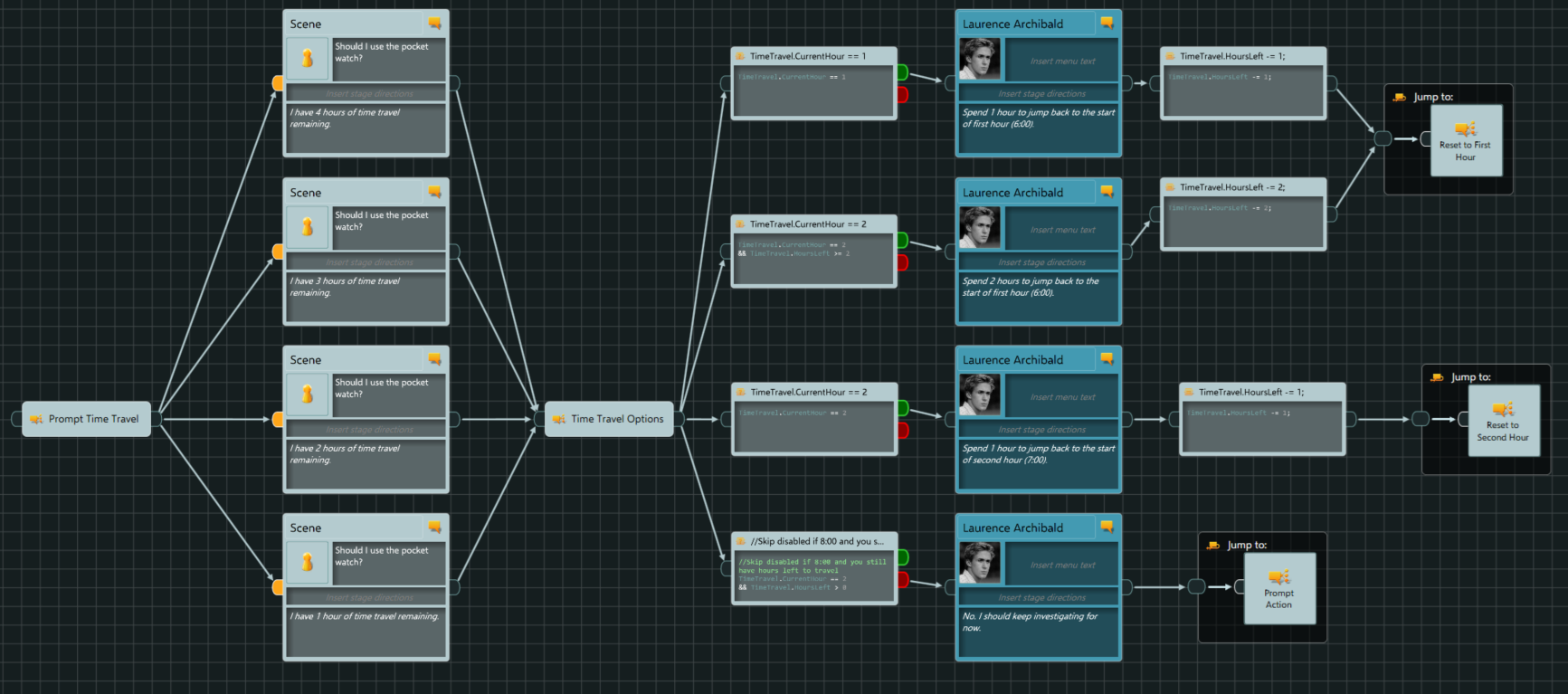
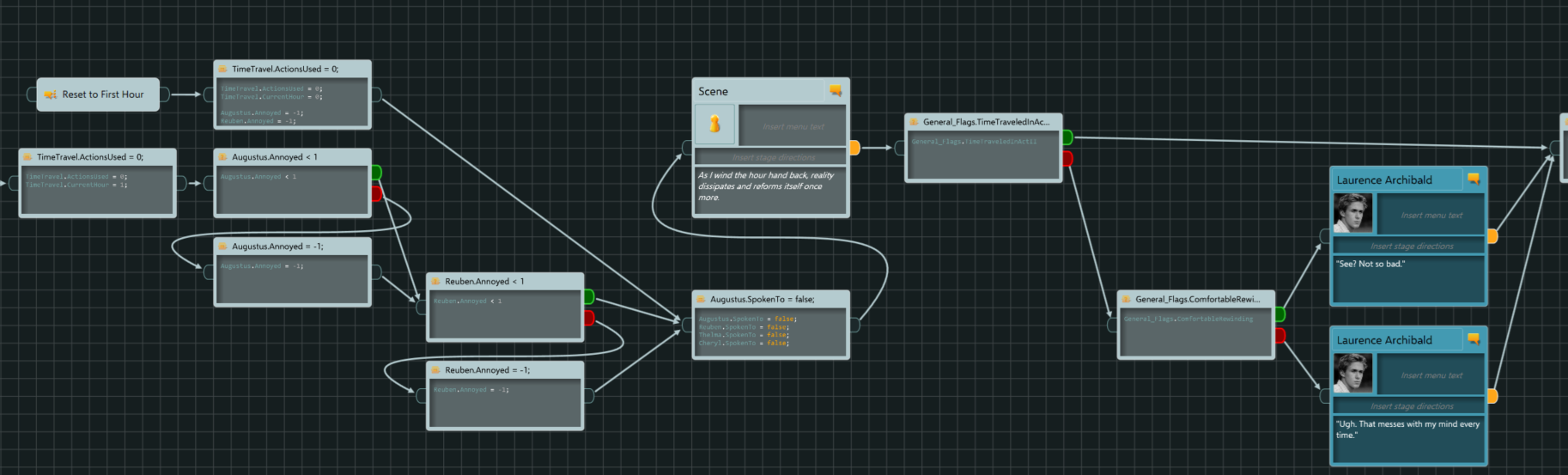
Small slices of game logic I implemented (Click to expand)
Pitching and Guiding
I came up with the initial concept for Tick Our Time Away, and after pitching it, a team formed around the project. Although various aspects of the original idea were inevitably iterated on and transformed, I helped guide the team towards the core vision I had for it. At the same time, I did some of the production work, such as assigning tasks and setting deadlines, towards the end of development to ensure its completion.
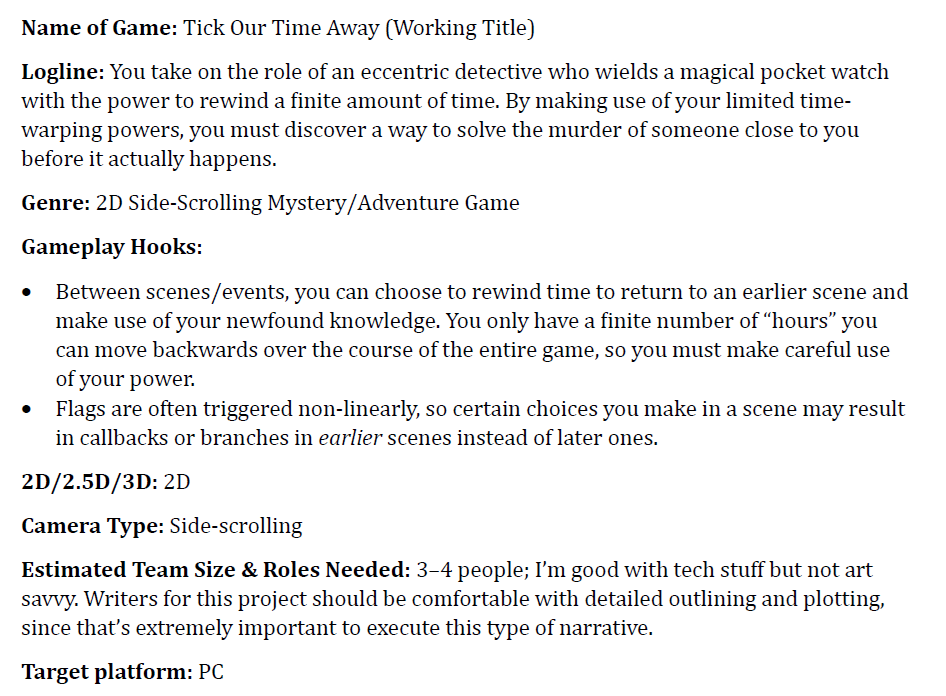
First draft of the original concept before it was simplified into a text adventure
 Connor Runyon